
· Maya Ellison
Acupressure Mat Before Bed: A Realistic Evening Routine
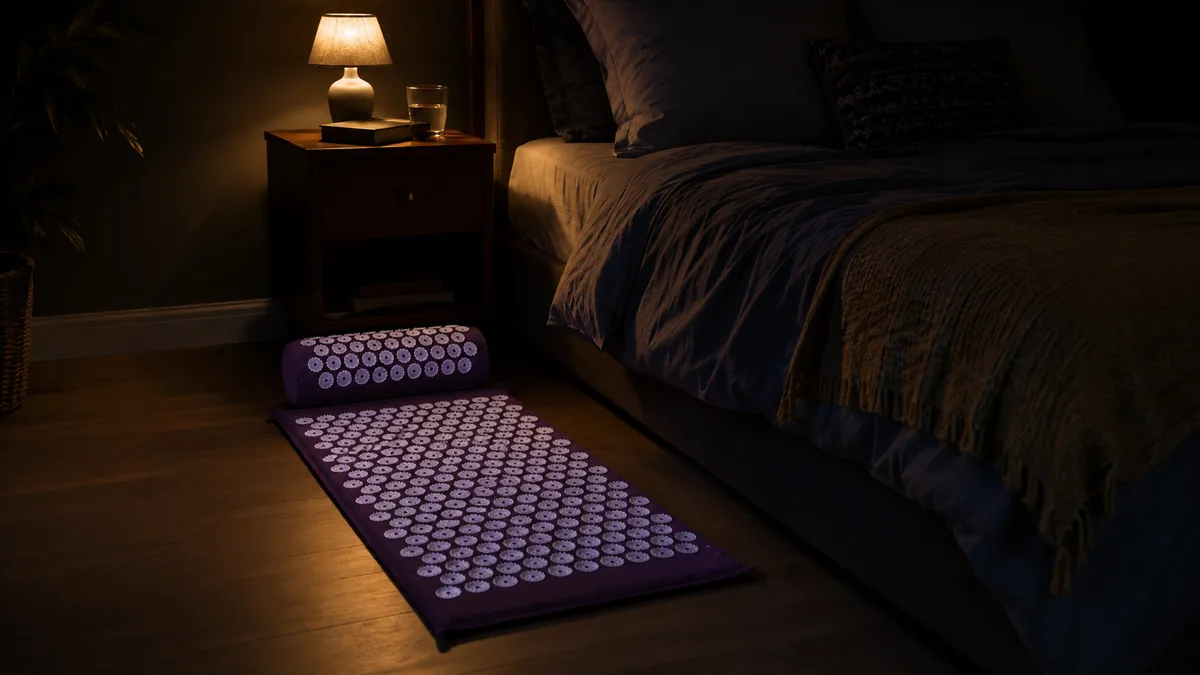
"Does an acupressure mat help you sleep" is one of the most common questions we get, and the short answer has two parts. First: many people build it into their evening wind-down and describe feeling calmer afterward — that part is well and consistently reported. Second: controlled research has not shown that an acupressure mat improves measured sleep more than relaxation alone does, so we are not going to tell you it cures insomnia or treats a sleep disorder. This guide covers a realistic before-bed routine, timing that actually fits an evening, and what to pair it with. For the full research picture, see our acupressure mat benefits page; for the basics of using the mat at all, see how to use an acupressure mat.
Why people reach for a mat before bed
Evening routines work partly because they are routines — a repeated signal that tells your body it is time to slow down. An acupressure mat fits naturally into that slot: it requires you to lie still, it gives your attention something to focus on besides a screen, and the first minute or two of sensation tends to pull your mind away from replaying the day. None of that is a medical mechanism. It is closer to how a warm shower or a cup of herbal tea works as a cue — the ritual matters as much as the tool.
A realistic before-bed routine
There is no single correct schedule, but a pattern that works for a lot of people looks like this:
- 30-45 minutes before bed: dim the lights and put the phone away. This is when most people place the mat session, early enough that you are not fully alert afterward, late enough that it flows into sleep.
- 10-15 minutes on the mat: lie on your back with the mat under your shoulders and upper back, bolster pillow under your neck if you have the set. Longer sessions are fine once you are used to the sensation, but 10-15 minutes is enough for most evening routines.
- Pair it with something calming: slow nasal breathing, a few pages of a physical book, or simply lying quietly. Screens tend to work against the point of the routine.
- Move straight into your normal bedtime steps — brushing teeth, turning off lights — right after, so the calm carries over rather than getting interrupted by more activity.
Pairing with reading or breathing
Two pairings come up most often in how people describe their routine. Reading a physical book while lying on the mat, or after a mat session, keeps the wind-down screen-free and gives the mind something gentle to focus on. Slow breathing — in for four counts, out for six, for example — is the other common pairing, especially during the first intense minute on the mat, when steady breathing helps most people move through to the warmer, more settled sensation. Neither pairing is required; some people prefer to simply lie in silence.
A 2021 randomized study added an acupressure mat to a supervised exercise program for chronic low-back discomfort; both the mat group and exercise-only group improved over six months, so the mat's independent contribution to the results is unclear
— Applied Sciences (MDPI), randomized controlled study, 2021
A relaxation-training study had beginners practice with or without an acupressure mat; perceived stress and well-being improved in both groups, across three weeks of practice
— Kisker et al., Applied Psychology: Health and Well-Being, 2024
An exploratory study on a spiked mat reported more relaxation during use, across the session
What users report after an evening session
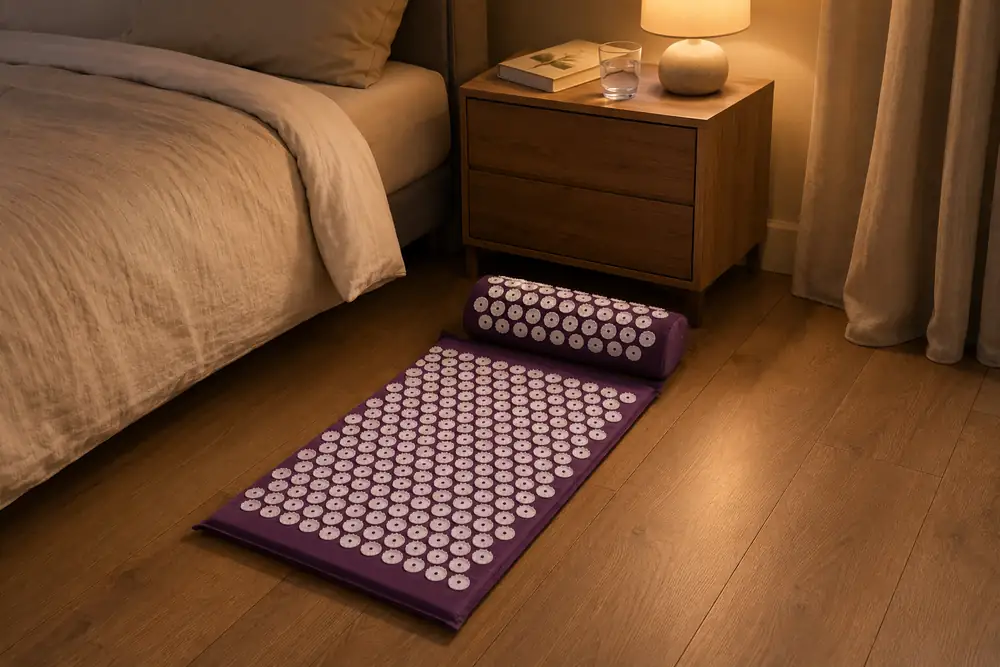
Reading through buyer feedback and the broader research together, a consistent pattern emerges: people say they feel calmer, describe the mat as part of "switching off" for the night, and often mention using it specifically because a hectic mind makes it hard to settle. Those are genuine, frequently repeated subjective reports, and we think they are worth taking seriously as a wind-down tool. The controlled research summarized on our benefits page points the same way: sleep-quality ratings improve when people actually practise winding down. The mat's job is to make that happen, because a spiked surface waiting on the floor is a far more reliable cue than a good intention.
| Commonly reported |
|---|
| Feeling calmer after an evening session |
| An easier time "switching off" before bed |
| A useful cue to start a wind-down routine |
| A warm, tingling sensation that fades into relaxation |
How Maya tracks her own evenings. As part of our how we test process, our curator Maya Ellison logged her own bedtime mat sessions across two weeks, noting the timing before lights-out and how quickly the initial intensity settled. Sessions placed 30-40 minutes before bed, paired with slow breathing, consistently felt easier to sit through than sessions rushed right before turning off the lights — likely because there was no pressure to hurry through the first intense minute. We publish that observation as a scheduling tip, not a sleep outcome.
How long and how often
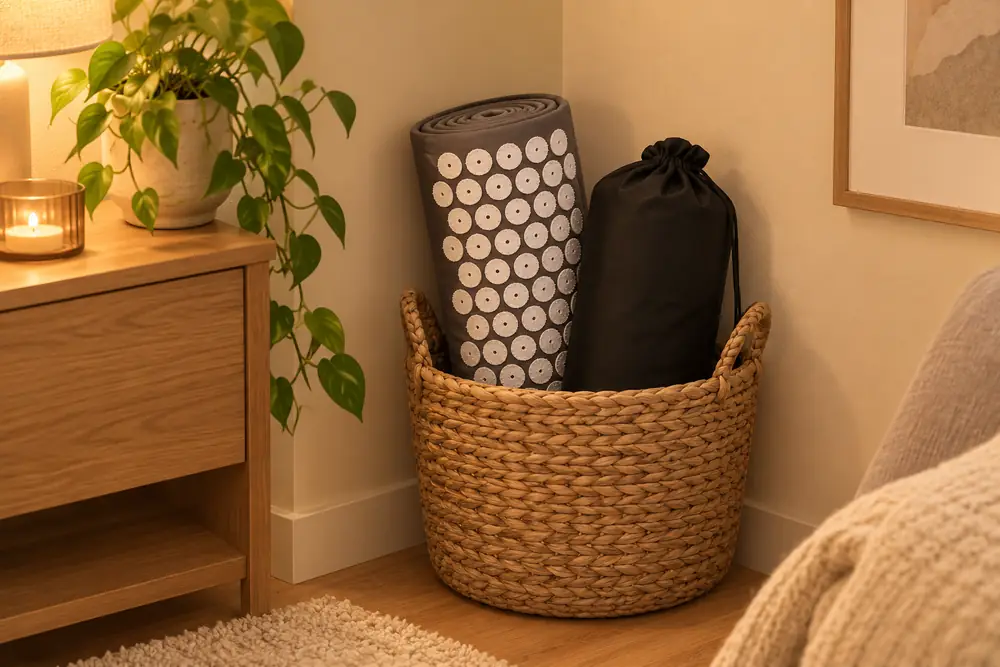
If you are just starting an evening routine, aim for consistency over duration — five to ten minutes done most nights is more likely to become a habit than twenty minutes done occasionally. As covered in our how-to-use guide, a thin shirt for the first sessions and a gradual build toward bare skin and longer sessions makes the routine easier to stick with in the first couple of weeks.
Who should check with a doctor first
Some people should talk to a doctor before adding an acupressure mat to an evening routine: those who are pregnant, take blood thinners, have broken or irritated skin, have reduced skin sensation (for example from diabetes or neuropathy), or have a heart condition. A relaxation routine is not worth the risk if any of these apply to you without medical guidance first.
Wellness disclaimer: SpikeRest mats are wellness products, not medical devices. They are not intended to diagnose, treat, cure, or prevent any condition, including insomnia or other sleep disorders. If you have a medical condition, are pregnant, or take blood thinners, talk to your doctor before use.
For a deeper look at what studies do and do not show about sleep and relaxation, read our acupressure mat benefits page. If this is your first time using a mat at all, our first session guide walks through exactly what to expect minute by minute, and our best acupressure mat comparison can help you pick the right set before you start a routine.

Maya Ellison · Wellness Product Tester & Curator, SpikeRest
Maya tests every mat on her own evening routines — timed sessions, one color at a time — and turns down more references than she approves. She logged two weeks of her own bedtime sessions to write this guide.
Reviewed and updated July 4, 2026. See how we test and our story. Read more on the SpikeRest blog.